Equipment and operating figures
Figures describe the configuration and operating conditions in this case.
- Complete machine
- 13 vision-guided robots and 22 conveyors
- Tray infeeds
- 6 × 2200 Series conveyors
- Coin transport
- 6 servo-driven timing belts, each 2 inches wide
- Empty-tray outfeeds
- 6 × 2200 Series conveyors
- Insert conveyor
- 3200 Series, 10 inches wide
- Insert rotation
- 180 degrees
The process sequence
- Feed trays of six coin types
- Unload rows onto servo belts
- Image and orient each coin
- Place coins into an insert
- Inspect and flip the insert
- Fit case lenses and load finished sets
A sequence extending beyond coin picking
The task involved placing several thousand coins into presentation cases. Each coin had to be picked, oriented and positioned in its insert well. The filled insert then had to be combined with the upper and lower clear case lenses.
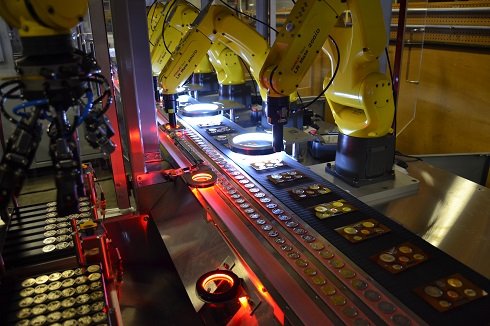
The complete machine combined thirteen vision-guided robots and twenty-two conveyors. Precision handling was therefore distributed across a coordinated system rather than performed by a single conveyor.
Tray feeds, imaging and empty returns
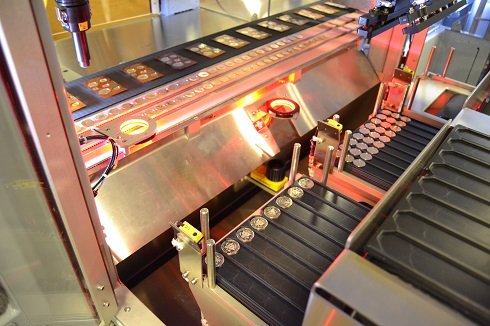
Six 2200 Series conveyors fed tray stacks containing six different coin types to the unloading robots. Each robot removed rows of coins and placed them onto its corresponding two-inch-wide servo-driven timing belt.
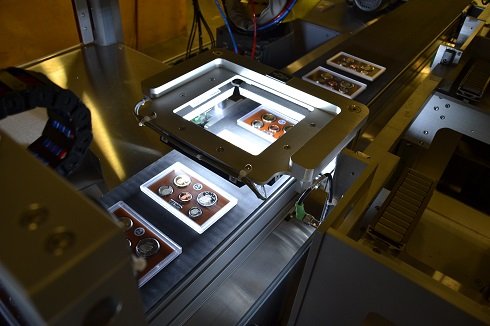
Each timing belt indexed coins to a camera station. The image identified rotational orientation, after which a paired placing robot picked and turned the coin before seating it in the correct insert well.
Once a tray was empty, a robot transferred it onto one of six separate 2200 Series outfeed conveyors. Keeping empty trays moving out was part of sustaining the infeed sequence.
Insert handling and presentation-case assembly
Another robot removed an empty insert from a stack, presented it to a camera and placed it onto a ten-inch-wide 3200 Series conveyor.
Completed inserts were picked by a flipper robot, inspected and passed through a device that turned them 180 degrees. For an acceptable insert, the top-lens robot selected and inspected a lens and placed it onto the downstream conveyor. The bottom lens was then picked and the assembly pressed together.
A final robot transferred completed sets into a trolley. The case therefore includes feeding, vision inspection, rotation, assembly and finished-product handling as well as the intermediate conveyor moves.
Conveyor integration features
The 2200 and 3200 platforms supplied low-profile transfer surfaces and T-slot frames for attaching accessories. Drive and control options allowed indexed movement to be programmed as part of the larger robotic system.
The conveyor dimensions and interfaces were selected for this application.
Application photographs